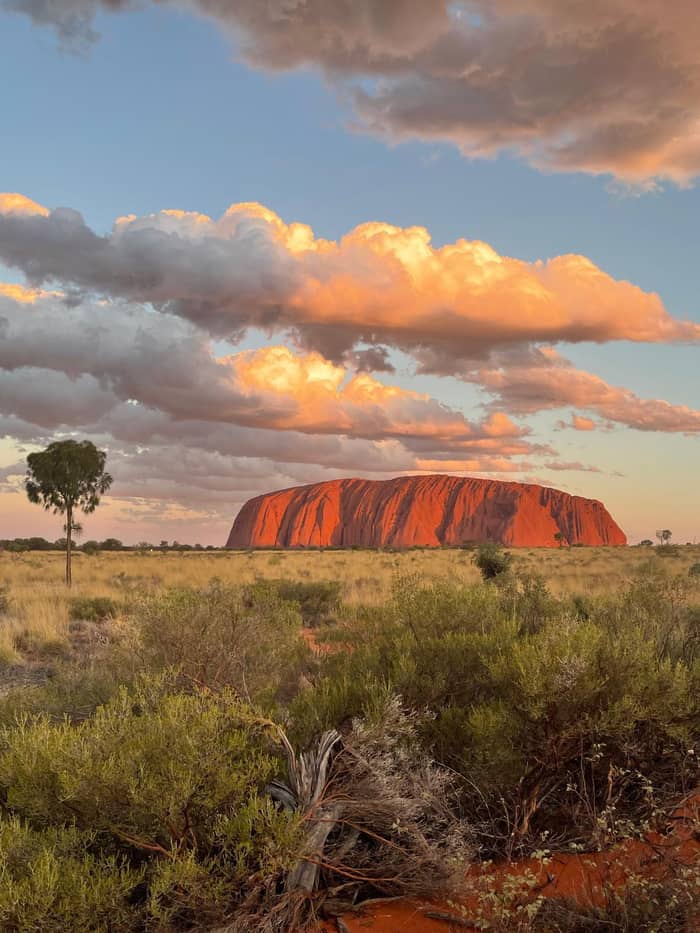
Start here
Cultural Centre
Tjukurpa Tunnel first
- Open7.00 am to 5.45 pm
- AllowAt least two hours
- ShopsAnangu-owned
Guides
Language
Currency
Look up datesfrom $279 · free to cancelDeciding made easy
The short version
Uluru is important because it is Anangu land held under Tjukurpa, handed back on 26 October 1985 and listed by UNESCO for both nature and culture.
Why it matters
Two taps to the stories
Say where you start and how you like to learn, and a matching listing appears with its from-price.
Best match for you
from $279
Guided walks in the park and at Mutitjulu Waterhole, time at the Cultural Centre and a sunset BBQ in 1 day.
Best match for you
from $230
7 hours from the resort hotels: the Cultural Centre, guided walks and a sunset BBQ.
Best match for you
from $174
About 10.5 km around the base with a guide, in a group of up to 11, over 6 hours.
Best match for you
from $132
3 hours with a picnic breakfast and a guide.
Why is Uluru important? Because it is far more than a big rock: it is Anangu land held under Tjukurpa, a place handed back, listed twice by UNESCO and visited by people from all over the world.
Editorial team, ulurudaytrip.com · Updated November 8, 2026 · 7 min reading time
Quick look
For Anangu, the traditional owners, the answer starts with Tjukurpa. Parks Australia describes it as the foundation of Anangu culture, and as the traditional law that tells people how to care for one another and for the land.1,8 Tjukurpa refers to the past, the present and the future at the same time.9 It is not history in the museum sense. It is the rulebook, the atlas and the scripture of a living people.
Tjukurpa stories also work like maps: they tell where important places are, how to travel between them, and where and when to find water and food.10 Walks around the base of the rock follow the tracks of ancestral beings, and the park calls Uluru and Kata Tjuta places where many creation stories meet. That is why a cave, a waterhole or a crack in the rock can carry a meaning a visitor does not see at first glance.
Not all of that knowledge is for visitors. Tjukurpa is not written down; it is held in memory and handed to the right people, the way an inheritance is.11 Anangu share many details with non-Aboriginal people, but the secret and sacred parts remain with senior Anangu, who are bound to protect them.12 A good visit accepts that limit without resentment. You are welcome to learn a great deal, and some things are simply not yours to know, which is true of sacred places all over the world.
Tourism, managed
| Issue | Rule today | Source of the rule |
|---|---|---|
| Climbing the rock | Closed since 26 October 20197 | Tjukurpa and the board's vote27 |
| Sensitive sites | No photographs28 | Anangu cultural protocols |
| Drones | Not allowed in the park29 | Park rules |
| Mutitjulu community | Permit or permission only30 | Community privacy |
| Alcohol | Only at the two sunset areas31 | Declared alcohol-free area |
| Leaving the tracks | Stay on marked paths32 | Protecting sacred areas |
Rules as Parks Australia states them; check signs on site, which mark sensitive areas.
The park's traditional owners are Pitjantjatjara and Yankunytjatjara people. Their own word for themselves is Anangu, and they ask visitors to say it too.17 Aboriginal people have lived around Uluru and Kata Tjuta for at least 30,000 years.18 A Traditional Owner's welcome on the park's website is direct: this is Anangu land, and you are welcome.19
Uluru itself is a Pitjantjatjara name, a proper noun with no English equivalent.20 The first outsider known to have seen it was William Gosse in 1873, who called it Ayers Rock in honour of Sir Henry Ayers, then a senior South Australian official.21 The year before, Ernest Giles had spotted Kata Tjuta and named its largest dome Mount Olga.22 Both names stuck on maps for more than a century.
In 1993 the rock became Ayers Rock / Uluru, the first feature in the Northern Territory to carry dual names, and in 2002 the order was reversed to Uluru / Ayers Rock, the official name today.23,24 Either name is correct. Inside the park, though, Parks Australia always uses Uluru, and so do we, because it was the name long before anyone else arrived, and because using it is a small courtesy that costs nothing.23
Where the pass money goes
In 1920 Uluru and Kata Tjuta were placed in the South West Reserve, set aside as a sanctuary for Aboriginal people.13 A dirt road reached the rock in 1948, and miners and tourists followed.37 The Ayers Rock National Park was declared in 1950, and in 1955 Len Tuit began regular tours, with guests in tents and drinking water carted in from Curtin Springs.14,38 In 1958 came the first permanent accommodation and an airstrip for fly-in groups.39
Tourism grew at Anangu's expense. They were discouraged from visiting the park during this period, though many kept travelling their homelands to hunt, gather food and attend ceremonies.40 In the 1960s some tour operators pressured the government's Native Welfare Branch to remove Anangu from the park.41 After pressure from tour operators, a settlement was set up at Kaltukatjara (Docker River) to draw Anangu away from the rock.42
The tide turned slowly. The Aboriginal Land Rights (Northern Territory) Act came into force in 1976.15 The deeds came back on 26 October 1985, handed over by the Governor-General at a ceremony on the Mutitjulu oval.16 As part of the deal, Anangu leased their land back to the federal parks agency, today Parks Australia, for a term of 99 years.43 That date, Handback, is the hinge of the park's modern story.
Where to learn
Start here
Tjukurpa Tunnel first
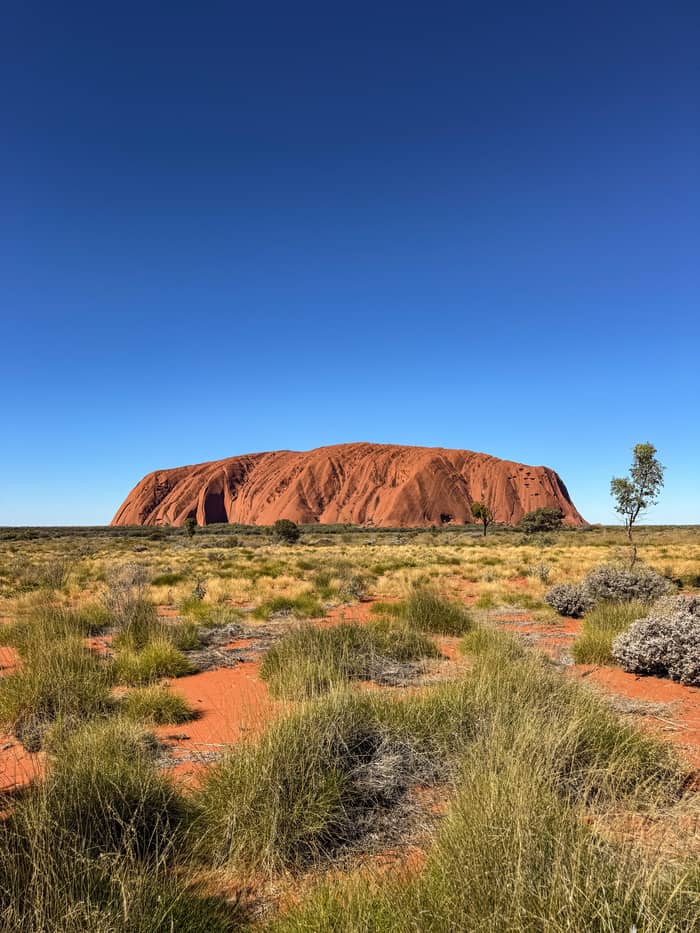
Daily
Free, guided
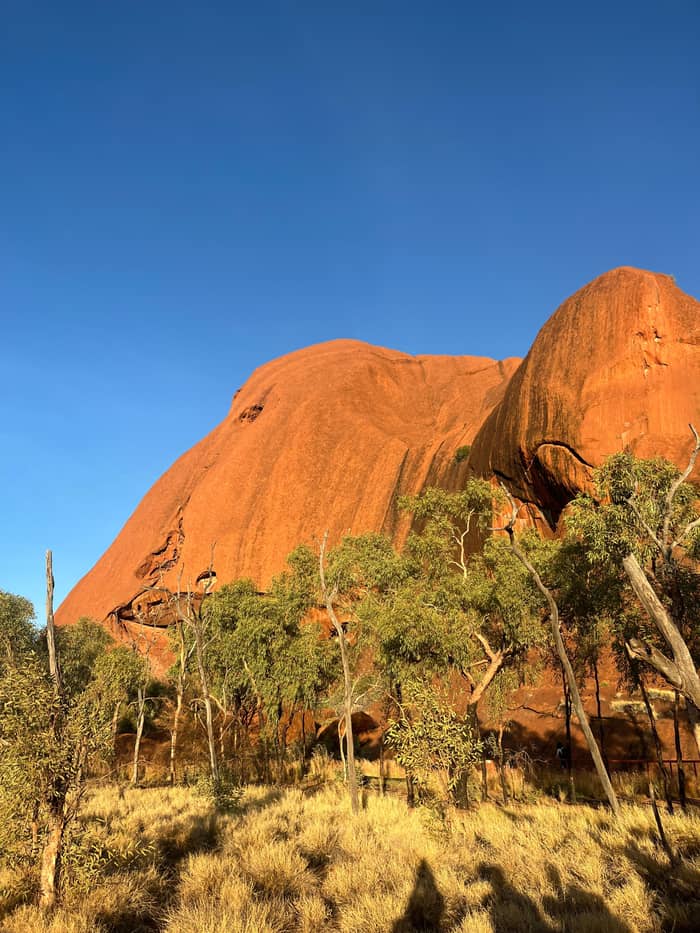
Short
Mutitjulu Waterhole
Since the 1985 handback the park has been jointly managed by Anangu and the Australian Government.47 A board of 12 people makes the major decisions, and eight of its members are Aboriginal people nominated by Traditional Owners.48 Tjukurpa guides everything that happens in the park, as it has for tens of thousands of years.2 On the ground, Mutitjulu Mala Rangers, Anangu residents, work on fire management, fauna surveys and park maintenance.49
UNESCO listed the park in 1987 for its natural values: its geological formations, rare plants and animals and natural beauty.4,50 In 1994 it was listed again as a living cultural landscape, recognising the relationship between the land and the belief system of Anangu, one of the oldest societies on earth.5,51 Only four Australian sites hold that kind of double listing.52
The natural case is easy to see. Uluru rises 348 metres above the plain, measures 9.4 km around and is made of sandstone about half a billion years old.53,54,55 Its species count runs to 21 mammals, 73 reptiles, 178 birds, 4 frogs adapted to the desert and over 400 plants.56 The cultural case takes longer to see, and that is the reason the Cultural Centre exists: it is where the second listing starts to make sense to a first-time visitor.
Learn on the ground
Choose a guided option and your group size.
Compare 3 side by side
Choose a guided option and your group size.
≈
View≈
View≈
ViewThese from-prices come from GetYourGuide and are converted using the ECB reference rate; the exact price shows at checkout.
Key dates
1920
Uluru and Kata Tjuta were included in a reserve set aside for Aboriginal people.13
1950
The Ayers Rock National Park was declared.14
1976
The Aboriginal Land Rights (Northern Territory) Act came into force.15
1985
Title deeds returned to Anangu on 26 October 1985, then leased back for 99 years.16
1987 and 1994
Listed for natural values in 1987 and as a cultural landscape in 1994.4
2019
The board's closure of the climb took effect on 26 October 2019.7
Climbing Uluru was not generally permitted under Tjukurpa.57 Visitors began climbing in the late 1930s, and the first section of the climb chain was installed in 1964 to keep people safe.58 For decades the climb was sold as part of the Uluru experience, even though the people who own the rock asked visitors not to do it.
In November 2017 the Board of Management, with the share of visitors climbing below 20% among its criteria, chose 26 October 2019 as the day climbing would end, a date that marked the 34th anniversary of Handback, and the vote was unanimous.27 The climb closed permanently on that date.7 Climbing now breaches the EPBC Act, and penalties are issued to anyone who tries.59
Former board chairman Sammy Wilson said the closure should be celebrated rather than regretted.36 That framing matters for visitors. The climb is gone, but nothing worth seeing went with it: the walks around the base, the rock art, the waterholes and the stories are all still there, and they are the parts of Uluru that Anangu actually want to share.
Video
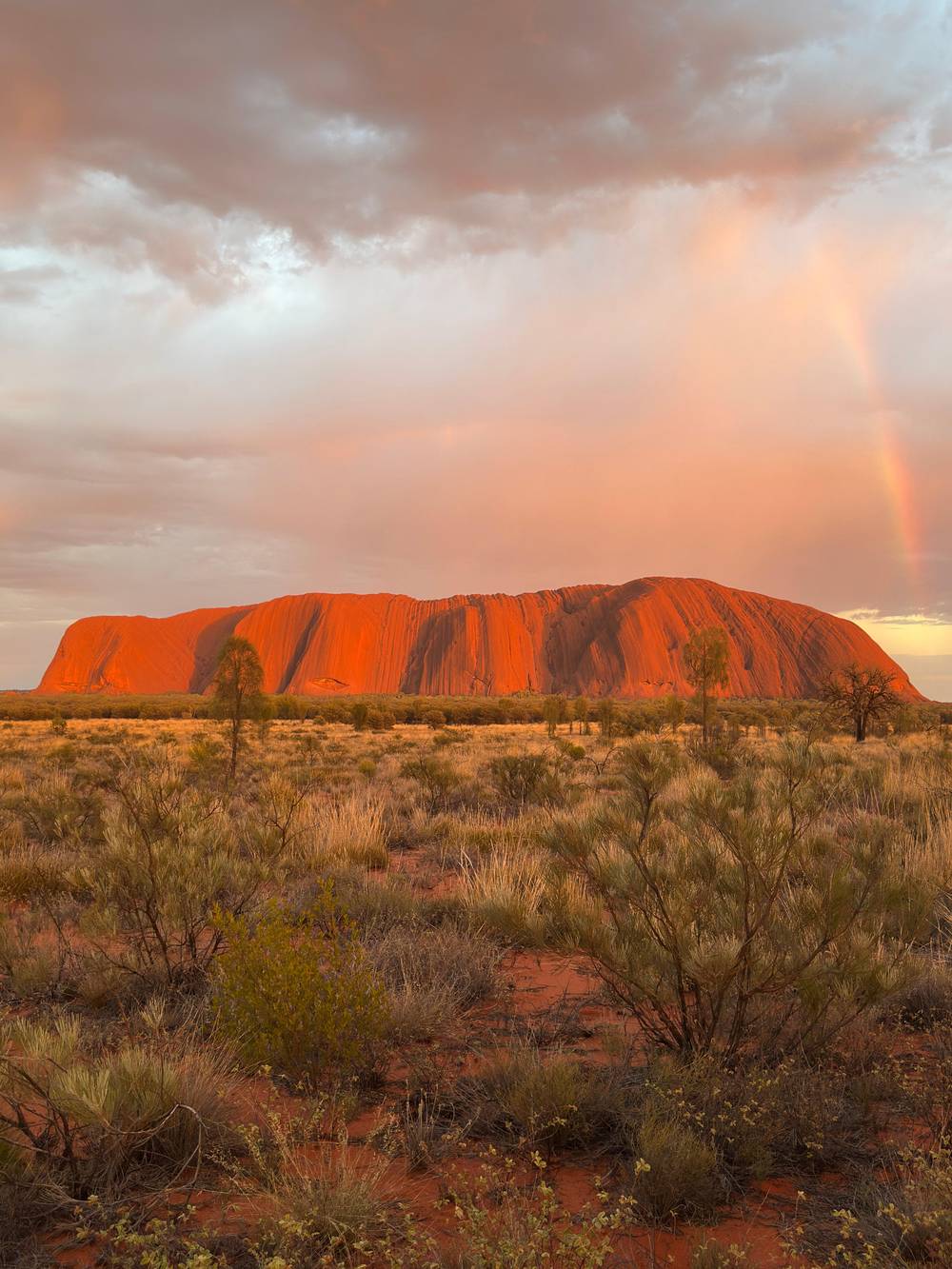
Life Out Loud on YouTube · The clip loads only after you tap play.
The land has law and Culture. We welcome tourists here. Closing the climb is not something to feel upset about but a cause for celebration. Let’s come together; let’s close it together.
Good manners
More than 250,000 people visit the park every year.6 The impact of tourism on Uluru has run both ways. Early tourism displaced Anangu from their own land, as the history above shows. Today the park is managed to limit the damage: Mutitjulu, the community inside the park, is closed and open only by permit or permission, and drones and other remote controlled devices are not allowed anywhere in the park.30,29
The money side has changed too. A quarter of park pass revenue, 25%, goes to Traditional Owner lease payments, with 40% for operations, 15% for ranger and cultural activities and 20% for natural and cultural preservation.25,26 Ayers Rock Resort at Yulara is an Aboriginal-owned enterprise whose workforce is now more than 40% Indigenous.60,61 The Indigenous Land Corporation bought the resort in 2011 and set up a national Indigenous training academy there.60
Spending at the rock can go straight to Anangu as well. The Ininti Store began in 1972 as an Anangu enterprise, and every business in the Cultural Centre today is Anangu-owned.62,35 Some tour operators share revenue too: the Segway operator sends 2.5% of each tour's price to Indigenous people nearby by way of the Central Lands Trust.63 The headcount at the rock matters less than how people visit, where they spend and what they choose to photograph.
Start with a word. The everyday Anangu greeting is palya, a word that also serves as welcome, thanks, understood, ok and goodbye.45 If someone stays silent while you talk, they are most likely listening or thinking about their answer, not ignoring you.46 The park asks visitors to let what they hear settle in their heart, which is a fine instruction for any trip.64
Then mind the camera. Restricted places, from sacred and ceremonial sites to burial grounds and people's homes, are off limits to both feet and lenses, and Anangu themselves should only be photographed with their permission.44 Culturally sensitive sites may not be photographed at all, because Anangu read their features as sacred scripture.28 Stay on marked tracks and do not climb onto rock formations or boulders.32
Finally, learn before you look. Parks Australia wants the Tjukurpa Tunnel at the Cultural Centre to be the first thing you see.33 After it, the free Mala walk with a ranger brings rock art, tools and creation stories told on the spot.34 The tour sold on this site includes guided walks in the park and at Mutitjulu Waterhole and time at the Cultural Centre, so the stories travel with you all day.
FAQ
Anangu hold the title and lease the park to the federal government.3
The title deeds went back to Anangu at Mutitjulu on 26 October 1985.16
Parks Australia says more than 250,000 people visit every year.6
The official name is Uluru / Ayers Rock, though the park itself always uses Uluru.24
Sources
Related guides
Only one day for Uluru? Ask a real person here.